
Someone looking for a new betting account pulls up a “best bonus offers” page. They scroll through operator logos, read a few quick takes, maybe click a star rating. What they probably don’t think about is who wrote the comparison or why certain brands appear at the top. Most of that content exists because of affiliate deals—commercial arrangements where the site owner earns a cut when readers sign up and place bets.
Australia’s market operates differently than most offshore jurisdictions. Licensed operators face advertising restrictions that make traditional deposit bonus campaigns tricky, which changes how partnerships get structured and what language affiliates can actually use. A lot of discovery happens on mobile now, with people finding operators through apps instead of sitting at a desktop browser. Browsing these comparison pages, users might see references to platforms like the Jackpot Jill app mixed in with other options, rarely considering that each link carries a commercial tracker.
The tension is real. Affiliates help operators acquire customers in a constrained advertising environment, but those same affiliates have to navigate compliance rules that aren’t always black and white. A misleading claim about withdrawal times or a bonus promotion phrased the wrong way can trigger action from state regulators or ACMA. Get it wrong enough times and the site gets blocked entirely.
What follows is a practical walk through how these partnerships function—payment models, tracking mechanics, compliance pitfalls, and the trust calculations that separate sustainable operations from the ones that eventually fall apart. No legal jargon, no marketing fluff.
What an Affiliate Partnership Really Is
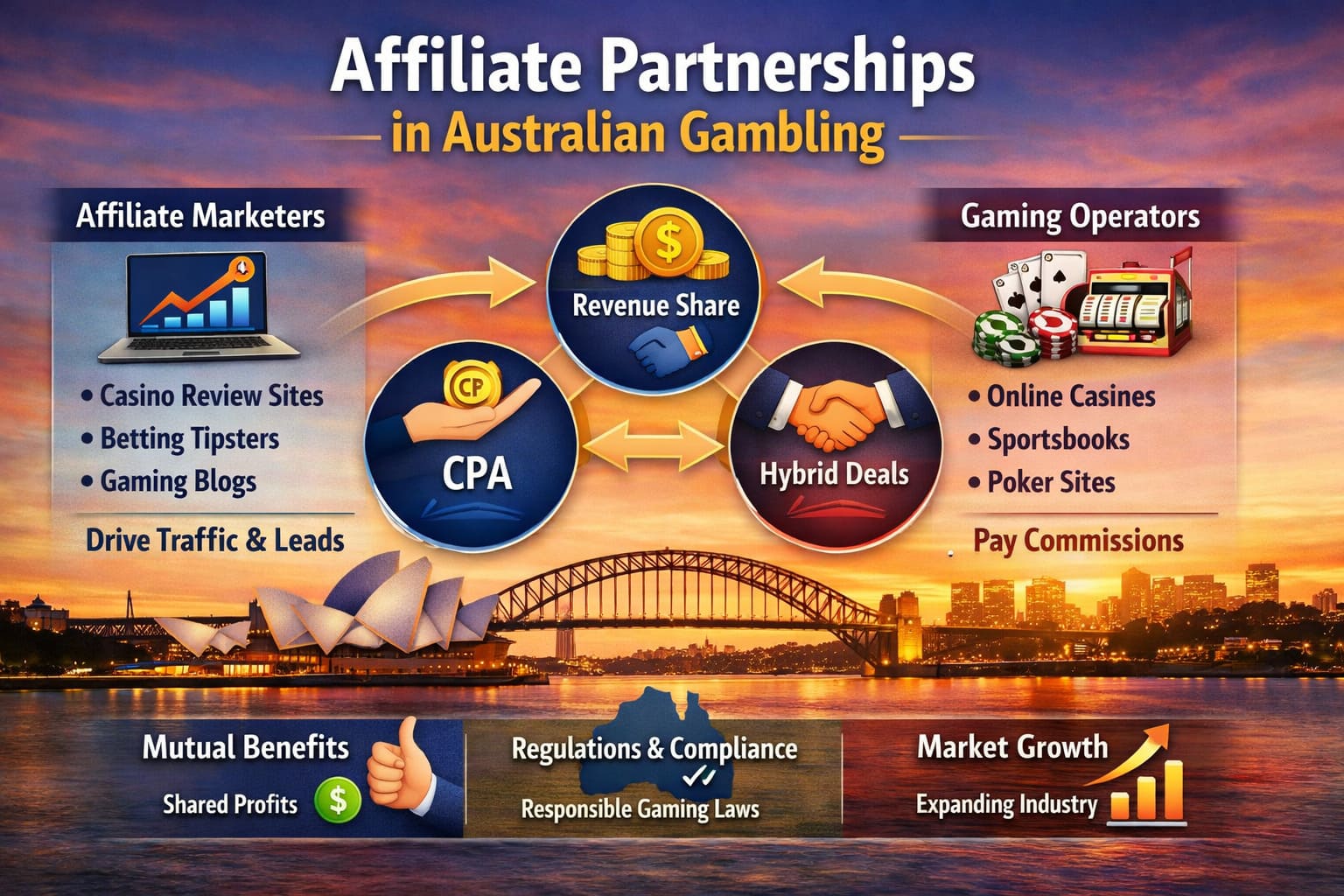
Strip away the terminology and an affiliate partnership is just a referral deal with performance tracking. An operator agrees to pay someone for sending customers who actually convert—meaning they register, deposit, or hit whatever benchmark the contract specifies. The affiliate drops tracking links into their content. When someone clicks through and completes the action, the affiliate gets paid. No conversions means no money in most setups.
Operators like this because they’re outsourcing customer acquisition to publishers who already have traffic flowing. Payment happens only when results show up, not for impressions or clicks alone. Affiliates benefit by turning their audience into revenue without needing to build a betting platform, handle licensing, or deal with customer complaints. The operator takes on product risk and regulatory headaches. The affiliate takes on traffic risk and reputation exposure if they promote brands that later collapse or slow-pay withdrawals.
Both sides keep optimizing. Operators test different landing pages, tweak welcome offers, watch which affiliates send customers who stick around longest. Affiliates compare conversion rates across operators, adjust their content mix, promote whoever’s paying best or converting strongest that month. If the numbers work, the relationship lasts. If they don’t, either side can walk away.
The Main Partnership Models
Commission structures break down a few ways depending on what the operator values and what the affiliate can actually deliver. Cost per acquisition means a flat payment when someone registers and meets a minimum deposit or wagering requirement. The operator absorbs the risk of whether that customer turns into a long-term player. The affiliate gets paid quickly but doesn’t see any upside if the customer becomes a high roller.

Revenue share flips that dynamic. The affiliate earns a percentage of net revenue generated by the customers they referred, calculated monthly. This ties both parties to customer quality—the affiliate makes more from valuable players but also takes a hit if those players go on a winning streak or churn fast. Some contracts include negative carryover, where the affiliate’s losses in one month get deducted from future earnings. That clause can be brutal during a bad run.
Hybrid deals split the difference with an upfront CPA payment plus ongoing revenue share, usually at a reduced percentage. Affiliates get immediate cashflow and long-term participation. Fixed placements work differently—paying for guaranteed visibility on a comparison page regardless of how many clicks or conversions happen. It’s closer to display advertising than performance marketing.
| Model | How It Pays | When It’s Used | Main Risk |
|---|---|---|---|
| Cost Per Acquisition (CPA) | Flat fee per qualified customer | New affiliates, short-term campaigns | Operator absorbs lifetime value uncertainty |
| Revenue Share | Percentage of net gaming revenue | Established affiliates, quality traffic | Affiliate earnings fluctuate with player luck |
| Hybrid | CPA upfront plus ongoing rev share | Balanced partnerships | Complex tracking, lower percentages |
| Fixed Placement | Set fee for visibility period | Premium comparison sites | No performance guarantee |
Who’s Involved
The ecosystem stretches beyond the obvious operator-publisher pairing. Affiliate networks provide the infrastructure between them—tracking technology, payment processing, compliance checks. They aggregate multiple gambling brands into one platform so affiliates can access dozens of programs without setting up individual integrations for each operator.
Publishers themselves range from large media operations running multi-vertical comparison sites to solo operators managing niche blogs about rugby league betting or poker tournament strategy. Some cover everything from credit cards to health insurance alongside gambling. Others stay exclusively in wagering content. Influencers represent a growing segment, especially on YouTube and Twitch where sports betting promotions tie directly into live match commentary.
Behind many of these sites sit SEO teams and content agencies creating the reviews and guides that actually rank in Google. They target search terms like “best betting sites Australia” or “online pokies real money” and optimize until those pages hit the first page. Media buyers handle paid traffic when organic reach isn’t cutting it—running campaigns through Google Ads, Facebook, or programmatic display networks.
- Licensed operators: Gambling companies holding state or territory licenses to legally offer wagering in Australia
- Affiliate networks: Platforms connecting operators with publishers while managing tracking infrastructure and payments
- Comparison sites: Publishers running side-by-side operator reviews, monetized almost entirely through affiliate commissions
- Niche publishers: Sites covering specific angles like horse racing tips, NRL betting angles, or tournament poker strategy
- Social media influencers: Content creators integrating gambling promotions into sports coverage or lifestyle content on YouTube, Twitch, Instagram
- SEO agencies: Teams working to rank content for high-value gambling search terms
- Affiliate managers: Staff at operators or networks who recruit publishers, negotiate commission structures, monitor performance
- Content writers: Freelancers or agencies producing the reviews, betting guides, and informational articles driving traffic
- Media buyers: Specialists managing paid campaigns across Google, Facebook, native ad platforms
- Compliance teams: People ensuring affiliate content doesn’t cross regulatory lines or trigger enforcement
Tracking, Attribution, and What Gets Measured
Tracking mostly runs on cookies or server-to-server postbacks. Click an affiliate link and a cookie lands in your browser with an identifier tied to that specific affiliate. Register within the cookie window—typically 30 days, sometimes longer—and the affiliate gets credited. Server-to-server setups use direct API calls between the operator’s platform and the affiliate network, which reduces dependence on browser cookies that people can delete or that ad blockers strip out.
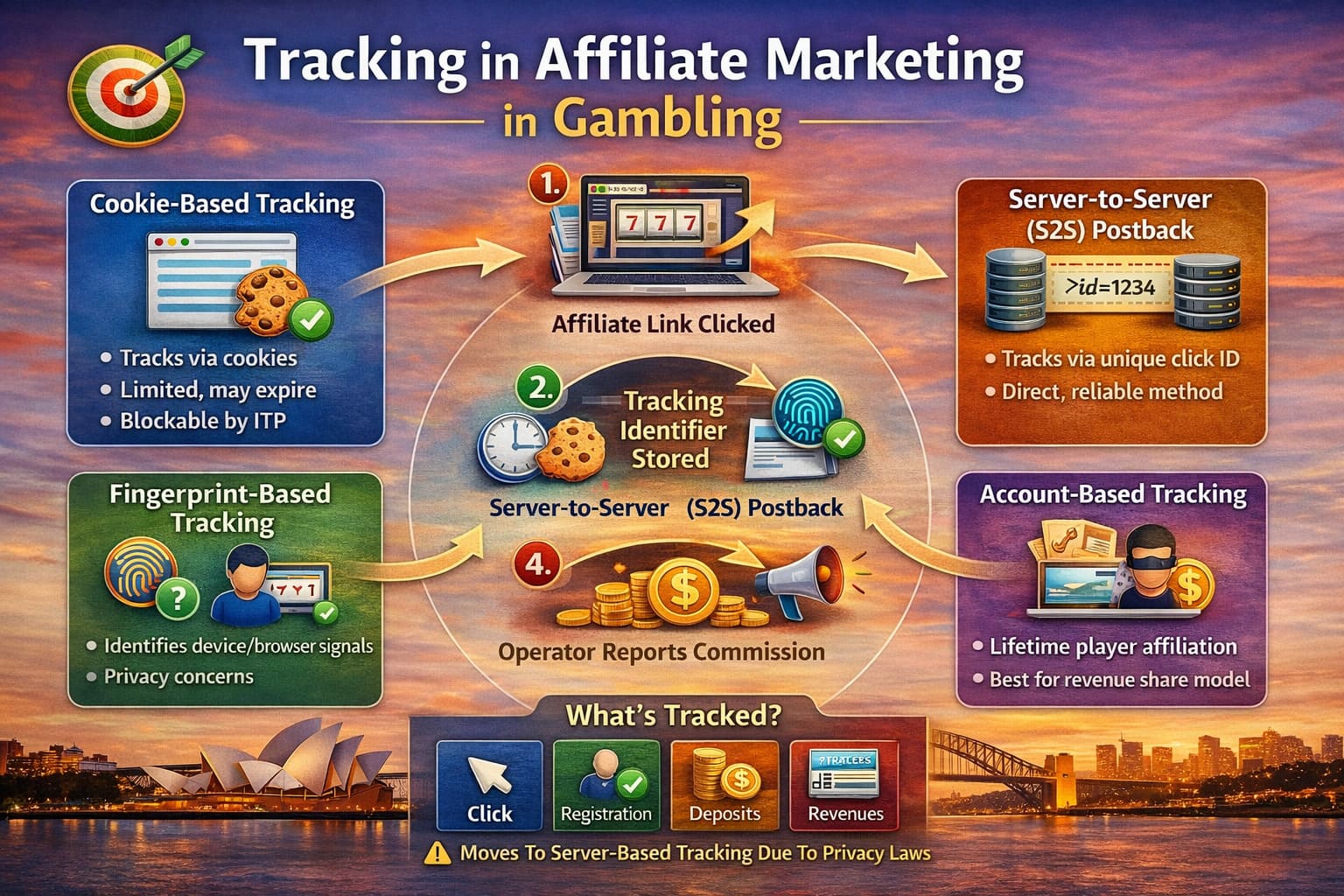
Attribution usually defaults to last-click. Someone clicks three different affiliate links before finally registering? Only the last affiliate earns anything. This creates competitive dynamics where affiliates fight to appear late in the customer journey, often through retargeting campaigns or bidding on the operator’s own brand terms in paid search. First-click models exist but they’re uncommon—operators prefer rewarding whoever closed the deal.
Registration counts aren’t the only metric. Operators track deposit rates, first-bet sizes, how long customers stick around, whether they come back in month two. Quality affiliates send traffic that converts and stays active. Lower-tier affiliates might deliver registrations that never deposit, or deposit once and vanish. Over time these patterns determine who gets better commission rates, bonus payments, or preferential placement in the network.
Picture a comparison site pulling 10,000 monthly visitors. Maybe 500 click through to operator sites. Fifty of those register accounts. Thirty make qualifying deposits. The affiliate earns CPA on those thirty, or starts accumulating revenue share based on their wagering activity. Meanwhile the operator’s dashboard shows which affiliates consistently deliver better deposit-to-registration ratios and adjusts future deal terms accordingly.
Compliance and Consumer Protection in Australia
Australian gambling advertising sits under multiple regulatory layers. The Interactive Gambling Act blocks certain services—online casinos, in-play sports betting—and restricts how licensed operators can promote themselves. Affiliates face the same penalties if they promote prohibited services. The Australian Communications and Media Authority can request ISP-level blocking of sites that repeatedly violate these rules.
Promotional material can’t include inducements like deposit bonuses in ways that breach state-specific regulations. What’s allowed in NSW might be restricted in Victoria. Affiliates writing content need to understand these distinctions or they risk compliance breaches that operators then push back onto them. A disclaimer saying “terms and conditions apply” doesn’t protect anyone if the underlying claim is misleading or the offer isn’t actually available in that jurisdiction.
ACMA investigated 20 affiliate marketing services in 2021-22 and found violations in every single one. Common problems included promoting unlicensed offshore operators, using Australian imagery to mislead consumers about local licensing, and missing responsible gambling messaging entirely. Affiliates who claim independence while only linking to whoever pays the highest commission can face scrutiny for deceptive conduct under consumer protection laws.
Responsible gambling messaging requirements keep expanding. Age-gating is mandatory. Affiliates can’t place ads near schools in some states or target content toward minors. The regulatory environment continues tightening as government reviews examine whether broader advertising bans are needed.
- Promoting unlicensed operators: Linking to offshore casinos or services without Australian licenses violates the Interactive Gambling Act
- Misleading bonus claims: Advertising deposit bonuses in prohibited formats or overstating value without clear wagering requirements
- Fake independence: Presenting paid placements as objective reviews without proper disclosure
- Missing disclaimers: Skipping age restrictions, responsible gambling links, or licensing details
- Hidden terms: Promoting offers without disclosing rollover requirements, maximum withdrawals, game restrictions
- Urgency manipulation: Countdown timers or “limited spots” language pressuring immediate registration
- Geographic deception: Using Australian flags, landmarks, or slang to imply local licensing when promoting offshore operators
- Bypassing self-exclusion: Suggesting workarounds for BetStop registrations or targeting excluded individuals
- Targeting minors: Placing gambling ads on content consumed primarily by children
Trust Is the Asset: What Readers Notice
Readers evaluate this content through instinct more than analysis. They notice when every single review ends with five stars and glowing praise. They question sites where the “cons” section mentions trivial interface complaints while ignoring documented payout delays or customer service disasters covered elsewhere online. They recognize template content that reads like it was batch-produced.
Building trust takes time. Losing it happens fast. A publisher who warns readers about an operator’s slow withdrawal processing—while still linking to that operator—earns credibility. A publisher who buries that information in tiny print or leaves it out completely sacrifices long-term audience retention for short-term conversion bumps. The trade-off shifts when readers realize they’re being steered toward whoever pays the most rather than whoever actually fits their needs.
Disclosure location matters more than whether it exists. A footer note stating “we may earn commissions” gets ignored. A clear statement near the top explaining the business model and what drives operator rankings registers differently with readers. Some publishers go further—listing commission rates by operator or explaining their testing process. Full transparency doesn’t eliminate the commercial relationship, but it acknowledges the dynamic instead of pretending it doesn’t exist.
| Trust Signal | What It Tells Readers | Easy Mistake | Better Approach |
|---|---|---|---|
| Balanced reviews | Publisher actually tested the product | Every operator gets 4.5 stars minimum | Include operators rated below 3.0 with documented reasons |
| Visible disclosure | Site acknowledges the commercial relationship | Generic footer link buried at bottom | Clear statement above rankings explaining commission structure |
| Specific criticism | Publisher isn’t afraid to lose affiliate income | Vague cons like “mobile app could be faster” | Document actual user complaints with evidence |
| Updated content | Information reflects current reality | Reviews from 2019 still ranking first | Date stamps with regular refresh schedules |
| Non-affiliate links | Site values reader utility over commissions | Every external link includes tracking parameters | Link to regulatory resources and help services without monetization |
Content Types That Perform Without Burning Credibility
Certain content formats naturally support affiliate monetization while maintaining reader trust. In-depth reviews documenting actual testing—screenshots of account dashboards, withdrawal timelines, customer service interactions—serve readers and convert them. Generic top-10 lists recycled across hundreds of sites accomplish neither goal effectively.
Explainer guides covering betting mechanics, odds calculation, or payment processing answer real search queries. These attract organic traffic from people early in their research, not just ready-to-convert users. Conversion rates run lower than straight comparison pages, but the audience often includes newcomers more likely to become steady customers if their first experience goes well.
Payment method guides perform unusually well in Australia, where people want to understand POLi, BPAY, or cryptocurrency deposits before choosing where to bet. These establish expertise and position the publisher as an information source instead of just a promotional funnel. Responsible gambling content rarely drives immediate conversions but signals editorial integrity that supports the site’s broader credibility with both readers and search engines.
- Deep operator reviews: Long-form analyses covering licensing verification, game libraries, tested payout speeds, customer service exchanges, real user feedback patterns
- Head-to-head comparisons: Feature tables comparing operators targeting the same customer segment with clear methodology notes
- Payment processing guides: Detailed breakdowns of deposit and withdrawal methods, typical processing times, fee structures, verification steps
- Betting education: Guides on odds formats, bet types, bankroll management principles that attract engaged readers
- State licensing breakdowns: Which operators hold valid licenses in each Australian state or territory
- Mobile app comparisons: iOS and Android betting app feature analysis with usability notes from actual testing
- Responsible gambling resources: Clear information on self-exclusion programs, BetStop registration, support services
- New operator launches: Early coverage of platforms entering the Australian market with license verification
- Industry news coverage: Regulatory changes, enforcement actions, major operator developments affecting users
- Dispute resolution guides: How to challenge transactions or file complaints with state regulators
Responsible Marketing (Not Just a Footer Link)
Responsible marketing here means avoiding tactics that exploit vulnerable users or pressure decisions people can’t afford. Age verification should load before content appears, not as a dismissible popup. BetStop, Gambling Help Online, and state self-exclusion programs deserve visible placement, not burial at the page bottom where nobody scrolls.
Language choices matter as much as technical compliance. Framing gambling as income generation or a financial solution crosses ethical boundaries even when it doesn’t technically violate advertising codes. Phrases like “guaranteed wins” or “beat the system” mislead readers about mathematical realities and house edges. Publishers can promote gambling services while being honest about the entertainment nature of the activity and the statistical likelihood of losing money over time.
Countdown timers, artificial scarcity claims, aggressive retargeting—these create urgency that pushes impulsive decisions. They might juice short-term conversions but they damage affiliate reputation and generate the kind of problem gambling that invites regulatory crackdowns. More operators now prefer affiliates who prioritize customer quality over raw volume, recognizing that problem gambling creates regulatory risk that outweighs temporary revenue gains.
A Practical Checklist for Better Partnerships
Both operators and affiliates benefit when partnerships get built on shared quality standards instead of just commission optimization. Clear criteria around content accuracy, disclosure practices, and compliance boundaries reduce disputes and regulatory exposure down the road. The checklist below outlines basic standards protecting both parties while maintaining reader trust.
Someone comparing platforms and deciding to Get the Jackpot Jill app or check out similar services is usually relying on affiliate content to guide that choice. Whether they have a smooth first experience or run into problems that should have been flagged upfront depends entirely on the quality of that guidance.
| Checklist Item | Why It Matters | Owner | Frequency |
|---|---|---|---|
| Verify operator licenses | Promoting unlicensed services risks ACMA enforcement | Affiliate | Before initial promotion, quarterly reviews |
| Test payout process | Readers blame the affiliate when withdrawals fail | Affiliate | At least once before recommending |
| Document promotion restrictions | Bonus advertising rules vary by state | Both | When regulations change |
| Review tracking accuracy | Attribution errors hurt affiliate earnings and operator data quality | Operator | Monthly |
| Update content dates | Outdated information misleads readers | Affiliate | Quarterly minimum |
| Audit disclosure language | Generic disclaimers don’t satisfy transparency standards | Affiliate | Semi-annually |
| Monitor customer complaints | Operator reputation issues become affiliate problems | Both | Ongoing |
| Include harm minimization | Demonstrates social responsibility beyond minimum compliance | Affiliate | Every piece of content |
Regular communication between affiliate managers and publishers prevents most problems before they escalate. Operators should notify affiliates when terms change, when new compliance requirements emerge, or when customer complaints spike around specific features. Affiliates should report patterns in user feedback, unexpected conversion drops, or competitor activity that might inform operator strategy adjustments.
Payment terms need documentation that doesn’t leave room for interpretation. Vague language around negative carryover, minimum payout thresholds, or commission tier triggers creates unnecessary friction. Some operators build in performance bonuses for hitting volume targets or maintaining above-average customer lifetime values. These incentives work better when the calculation methodology is transparent and verifiable through the affiliate dashboard rather than announced retroactively.
Conclusion
Affiliate partnerships drive customer acquisition across Australia’s legal wagering sector. They fund the comparison sites, review platforms, and informational content helping users navigate operator choices. The commercial incentives are straightforward—operators pay for results, affiliates monetize traffic, both optimize for conversions. What’s less obvious to most readers is how compliance constraints, trust dynamics, and content quality standards separate partnerships that last from ones that collapse under regulatory pressure or reputational damage.
Australian regulations create specific challenges around what can be promoted and how it can be messaged. State-by-state variations add complexity. ACMA’s enforcement actions against affiliate sites prove that publishers carry genuine legal exposure, not just operators. Meanwhile readers have developed pattern recognition for low-quality affiliate content. Sites prioritizing commission optimization over accuracy eventually lose audience trust and organic traffic along with it.
The partnerships that survive long-term get built on aligned incentives around customer quality, regulatory compliance, and content standards readers actually trust.